
- All
- Product Name
- Product Keyword
- Product Model
- Product Summary
- Product Description
- Multi Field Search
Views: 0 Author: Site Editor Publish Time: 2026-05-21 Origin: Site


Brands constantly seek innovative ways to elevate shelf presence and capture consumer attention. Upgrading to premium packaging formats serves as a powerful differentiator in crowded retail environments. Flat bottom pouches deliver maximum shelf stability alongside five distinct panels dedicated entirely to branding, making them a top choice for premium private label packaging products.
Transitioning to this sophisticated format often brings unforeseen technical challenges. Companies must navigate complex structural material choices to guarantee product freshness. They also face rigid minimum order quantities capable of straining procurement budgets during initial rollouts.
We provide a vendor-neutral framework to simplify this packaging transition. You will learn how to evaluate material structures based on precise barrier requirements. We also explain production volume drivers and guide you through shortlisting a reliable manufacturing partner without over-committing your capital.
Material selection must balance product barrier requirements (moisture, oxygen) with emerging compliance standards for recyclable structures.
MOQ in eight-sided seal pouch OEM manufacturing is dictated primarily by the printing method: digital printing allows for flexible MOQs, while rotogravure requires higher volumes but yields lower unit costs.
Customizing value-add features (valves, resealable zippers) directly impacts both lead times and unit economics for private label packaging.
Vetting an OEM requires verifying third-party quality certifications (e.g., ISO, FDA-grade materials) and assessing their defect-resolution protocols.
Retail environments demand packaging capable of standing out visually while protecting the product inside. Brands upgrade to the flat bottom format specifically for its unmatched structural advantage. Unlike traditional stand-up pouches relying on a single bottom gusset, this design features a completely flat base. This structural integrity prevents tipping over on grocery shelves, projecting a premium, organized appearance. Furthermore, it provides five printable sides: the front, back, two side gussets, and the bottom. This layout maximizes branding real estate. You can place prominent logos on the front, detailed brand stories on the side gussets, and reserve the back for nutritional information, keeping the primary display panel clean and uncluttered.
Volume efficiency represents another major operational advantage. The distinct box-like shape holds significantly more product volume per square inch of material compared to standard three-side seal or traditional stand-up pouches. This efficiency translates directly into supply chain benefits. Consider the following logistical improvements:
Maximized Internal Capacity: The squared edges eliminate dead space inside the bag, allowing more product fill weight without increasing the overall pouch height.
Freight Optimization: Box-shaped bags pack neatly into master shipping cartons, reducing wasted space and lowering shipping costs per unit.
Warehouse Density: Tightly packed master cartons stack more securely on pallets, maximizing valuable storage space in distribution centers.
These structural and logistical benefits make this format highly sought after for specific target applications. High-barrier products benefit the most. Specialty roasted coffee, premium tree nuts, organic pet food, and specialized diet snacks typically utilize this format. These heavy or bulky items require the physical stability the flat bottom provides, ensuring they remain upright and visually appealing long after they reach the consumer.
Selecting the right eight-sided seal pouch material depends entirely on understanding flexible packaging anatomy. Manufacturers build these bags using a multi-layer lamination principle. Each layer serves a highly specific function. The outer layer provides the printing surface and physical puncture resistance. The middle layer acts as the core barrier, blocking oxygen, moisture, and UV light. The inner layer serves as the food-contact surface and melts under heat to create a hermetic seal.
Choosing between standard and high-barrier laminations depends on your product's sensitivity to environmental factors. Fast-moving consumer goods like standard chips or wrapped candies often perform perfectly well in standard structures. Highly sensitive goods require robust foil or metallized film barriers. The table below outlines common structural choices.
Lamination Type | Material Structure | Barrier Level | Best Suited For |
|---|---|---|---|
Standard Protection | PET/PE or BOPP/PE | Low to Medium | Fast-moving snacks, dry pasta, individually wrapped items |
High-Barrier (Metallized) | PET/VMPET/PE | High | Premium tree nuts, granola, dehydrated fruits, pet treats |
Maximum Barrier (Foil) | PET/AL/PE | Ultra-High | Roasted coffee beans, matcha powder, sensitive nutritional supplements |
The packaging industry currently faces a massive shift toward sustainable and recyclable options. Brands increasingly request Mono-PE (polyethylene) and Mono-PP (polypropylene) structures. Because these pouches use a single material family across all layers, recycling facilities process them much easier than mixed-plastic laminations. However, adopting sustainable materials carries implementation risks. Mono-material films naturally exhibit a slight compromise in oxygen barrier performance compared to traditional aluminum foil. If you transition a highly sensitive product to a recyclable pouch, you must conduct rigorous shelf-life testing to ensure freshness remains uncompromised.
Regardless of the chosen lamination, compliance verification remains non-negotiable. Always demand up-to-date compliance certificates from your manufacturer. Valid documentation must confirm the inner sealing layer meets food-safety standards. Request FDA, SGS, or EU compliance testing reports specifically for the food-contact layer. Failing to verify these documents exposes your brand to severe regulatory risks and potential product recalls.
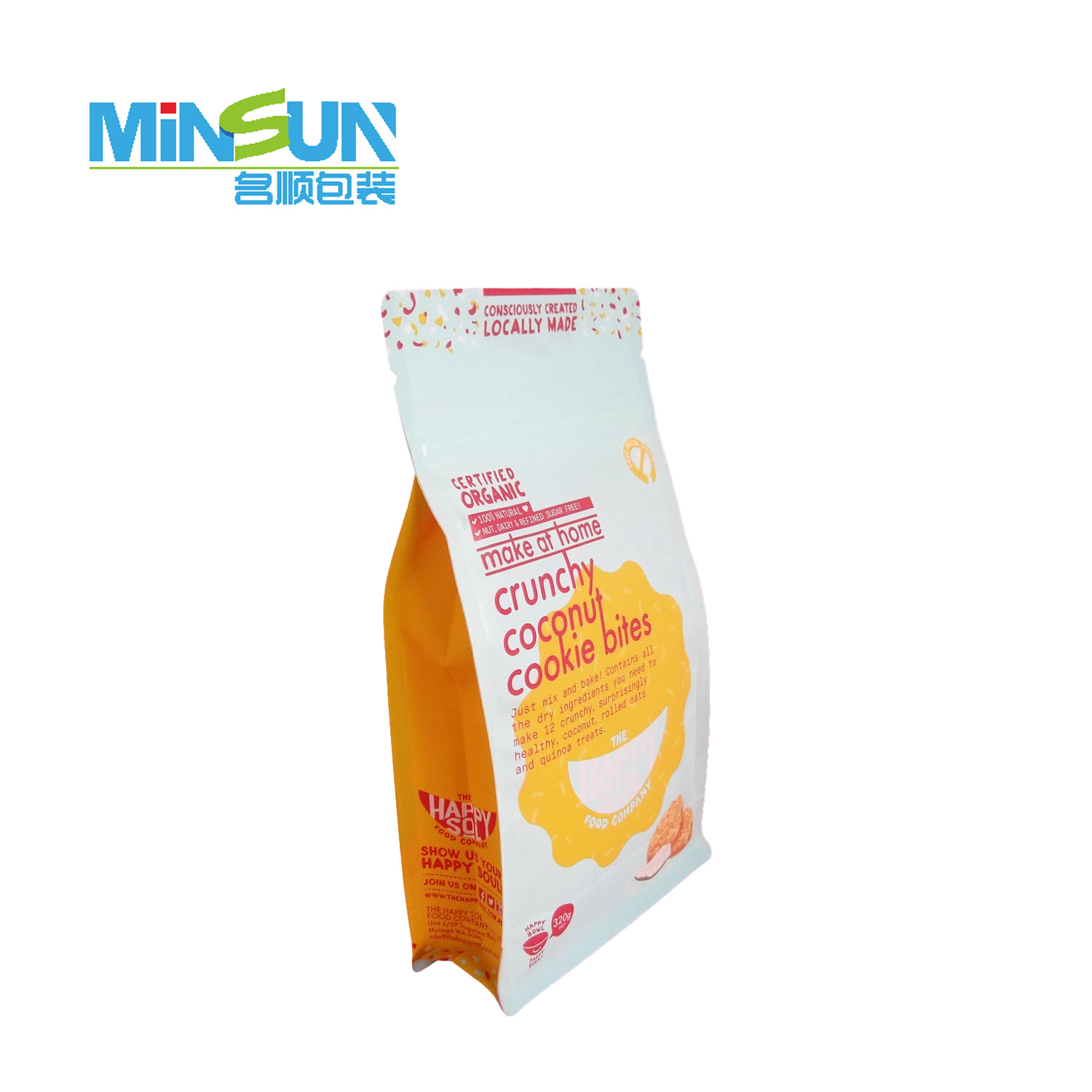
Understanding minimum order quantities in eight-sided seal pouch OEM manufacturing dictates your entire sourcing strategy. Manufacturers do not set MOQs arbitrarily. The core driver determining these volume thresholds is the specific printing technology utilized on the production floor.
Rotogravure printing represents the traditional industry standard. This method involves engraving your artwork onto solid copper cylinders. Each color in your design requires a separate cylinder. Because manufacturing and setting up these heavy metal cylinders demands significant time and labor, factories enforce high MOQs to justify the machine setup. Typically, rotogravure demands an order of 10,000 to over 30,000 units per SKU. This method works best for established product lines requiring exact Pantone color matching and massive volume runs.
Digital printing completely changes the volume dynamic. This modern technology eliminates copper cylinders entirely. The printer applies ink directly to the outer film layer, much like a commercial office printer. Because digital machines require minimal physical setup, they allow for highly flexible MOQs. Buyers can often order between 1,000 and 5,000 units per SKU. Digital printing serves as the ideal solution for market testing, launching multi-SKU product variations, or rolling out seasonal promotional designs.
Printing Method Comparison Chart | ||
Feature | Rotogravure Printing | Digital Printing |
|---|---|---|
Typical MOQ | 10,000 - 30,000+ units | 1,000 - 5,000 units |
Tooling Fees | High (Copper Cylinders required) | None |
Color Accuracy | Perfect Pantone Matching | CMYK Blending (Slight variation possible) |
Best Use Case | High-volume, established retail products | Market testing, seasonal SKUs, startups |
Buyers must approach the procurement process wearing a highly skeptical lens. The market features numerous suppliers aggressively advertising ultra-low MOQs at rock-bottom prices. These offers frequently mask hidden setup fees added onto the final invoice. More concerningly, some suppliers hit these low price points by compromising on material thickness or substituting lower-grade barrier films. Always request a detailed specification sheet confirming the exact micron thickness and material layers before signing a purchase order.
Customizing your packaging transforms a basic container into a premium user experience. However, every added feature influences the manufacturing process, altering lead times and production efficiency. Balancing these enhancements against your budget requires careful consideration.
Resealable closures remain the most requested functional upgrade. Consumers expect multi-serve products to stay fresh after opening. Standard press-to-close zippers offer reliable, cost-effective resealability. Slider zips provide enhanced convenience but require specialized machinery to attach, often increasing unit costs. Pocket zippers (often called front-tear zippers) represent a premium option. They allow the manufacturer to leave the top completely open for high-speed filling. The consumer then pulls a perforated strip on the front panel to reveal the hidden zipper. Selecting the right zipper type directly impacts your co-packer's ability to fill the bags efficiently.
Freshness mechanisms prove critical for certain active ingredients. Roasted coffee beans naturally emit carbon dioxide for weeks after roasting. If sealed in an airtight bag, the trapped gas will cause the pouch to swell and eventually rupture. One-way degassing valves solve this issue. These small plastic vents allow internal CO2 to escape while physically blocking external oxygen from entering. Adding a valve requires an extra die-cutting and heat-welding step during production.
User experience features subtly communicate brand quality. Consider integrating these functional design elements:
Laser-Scored Tear Notches: Provide a clean, straight tear across the top of the pouch, preventing consumer frustration when opening.
Transparent Viewing Windows: Allow shoppers to inspect the physical product, building immediate trust in product quality.
Rounded Corners: Eliminate sharp, abrasive plastic edges that can damage adjacent bags during shipping or scratch consumers' hands.
Aesthetic finishes dramatically alter shelf appeal. Matte finishes communicate organic, artisanal, or premium qualities. Gloss finishes make vibrant colors pop and draw the eye in brightly lit aisles. Soft-touch finishes add a tactile velvet-like feel to the surface. Spot UV techniques apply a high-gloss coating to specific logo elements against a matte background, creating striking contrast. When selecting matte or soft-touch finishes, advise your logistics team to monitor scuff resistance. These elegant surfaces occasionally show transit abrasions more clearly than standard gloss films, making tight master-carton packing essential.
Securing a capable manufacturing partner requires looking beyond glossy websites and aggressive sales pitches. You must differentiate actual factories from intermediary trading companies. Trading companies often present themselves as manufacturers but outsource the actual production, limiting your control over quality and timelines. Verify capabilities by requesting virtual video tours of their production floor. Ask to see the specific printing presses, lamination machines, and pouch-forming lines. Vetting an OEM pouch partner requires confirming they directly control the machinery producing your goods.
Quality assurance protocols separate reliable partners from risky ones. The flexible packaging industry generally accepts a defect rate below one to two percent. Ask candidates detailed questions regarding their seal integrity testing. Capable factories perform routine vacuum leak testing. This involves submerging a sealed, air-filled pouch in a water chamber and applying a vacuum. If bubbles escape, the machine operator immediately halts production to recalibrate the heat sealing jaws. Drop testing also proves vital. Dropping fully loaded pouches from standard shelf heights verifies the bottom gusset welds can withstand retail handling.
Prototyping prevents catastrophic mass-production errors. Never commit to a multi-thousand unit order without physical testing. Request unprinted structural samples made from your chosen material structure. Fill these blank samples with your actual product. This simple test confirms whether the physical dimensions accommodate your required fill weight. It also allows you to test the zipper functionality and verify the flat bottom sits perfectly level.
Lead time transparency dictates your product launch schedule. Standard rotogravure production typically takes three to four weeks post-artwork approval. Digital printing often cuts this time in half. However, material shortages, power rationing, or shipping port congestion frequently disrupt timelines. Evaluate how the manufacturer handles these delays. A trustworthy partner proactively communicates supply chain bottlenecks and offers expedited air-freight options for partial batches to keep your launch on track.
Sourcing the perfect flat bottom pouch requires aligning your product’s specific barrier needs with the correct multi-layer material structure. You must select a printing method fitting your immediate inventory strategy, balancing flexible digital testing against efficient rotogravure scaling. Prioritizing functional features like degassing valves or pocket zippers ensures the final product meets consumer expectations while protecting brand equity.
Your immediate next step involves preparing a comprehensive Request for Quote (RFQ). Detail your exact physical dimensions, requested material thickness, and required barrier levels. List out every necessary customization, from tear notches to specific zipper styles. Providing target order volumes immediately clarifies whether you need digital or rotogravure pricing. Armed with this structured data, you can confidently approach shortlisted manufacturers and secure accurate, competitive bids.
A: Eight-sided seal pouches feature a completely flat bottom and two independent side gussets, creating a box-like shape. This design yields five distinct printable panels and prevents shelf tipping. Standard stand-up pouches utilize a single bottom gusset and taper together at the top seal, offering only two main branding panels.
A: Custom windows require physical die-cutting integration on the manufacturing line. Adding unique shapes or windows often pushes the order back into higher rotogravure-level MOQs to justify the machine setup. Digital printing typically relies on standardized physical pouch shapes to maintain low minimum order thresholds.
A: Yes, cylinder fees represent a one-time tooling investment per specific design and SKU. As long as your artwork layout, physical pouch dimensions, and color profiles remain identical, the manufacturer will reuse the same engraved cylinders for all future reorders without charging the setup fee again.
A: Once you approve the final digital artwork, digital printing typically requires 10 to 15 days for production. Rotogravure production takes longer, averaging 20 to 30 days due to cylinder engraving. You must add corresponding air freight or sea freight transit times to calculate the final delivery date.


