
- All
- Product Name
- Product Keyword
- Product Model
- Product Summary
- Product Description
- Multi Field Search


Views: 0 Author: Site Editor Publish Time: 2026-02-05 Origin: Site


Have you ever wondered if kraft paper is truly waterproof? Many assume it offers complete protection from moisture, but that’s not always the case.
In this article, we’ll explore the limitations of kraft paper, particularly in products like kraft paper bags with window. You’ll learn how its natural properties affect moisture resistance and whether it needs extra protection.
Kraft paper is made from wood pulp fibers that are processed to retain length and strength. These fibers interlock tightly, which improves tear resistance and load capacity. At the same time, the fiber network remains porous, leaving microscopic gaps between fibers. This structure allows water to move into the material when exposed to liquid, including in common uses such as kraft paper bags with window. Porosity is not a defect but a natural property of paper. It explains why water absorption occurs even when the paper feels thick or rigid.
The way kraft paper reacts to water is often confused with how it performs under mechanical stress. Mechanical strength describes how well the paper resists tearing, stretching, or carrying weight. Resistance to liquid penetration depends on whether water can pass through or be blocked at the surface. In untreated kraft paper, strength does not prevent absorption. Once water enters the fiber structure, it disrupts bonding between fibers. This leads to softening, loss of stiffness, and gradual deformation.
Because of this behavior, untreated kraft paper is classified as absorbent rather than waterproof. It can tolerate low humidity and brief contact with dry hands, but it does not stop liquid from passing through. Moisture moves through the material by capillary action rather than surface runoff. For packaging applications, this means natural kraft paper should be evaluated based on exposure conditions. Its performance is defined by how much moisture it encounters, not by how strong it feels when dry.
Kraft paper bags with window introduce more complexity than solid paper bags. The window opening creates transitions between paper and transparent film, while seams and bonding areas add structural variation. These junctions often respond differently to moisture than flat paper surfaces. In practice, moisture tends to enter through edges, folds, or seals first. Construction details can therefore influence moisture behavior as much as the paper itself.
Moisture exposure usually appears in several distinct forms, each affecting the bag differently:
● Ambient humidity, which slowly increases moisture content in the paper fibers
● Condensation caused by temperature differences that create water droplets
● Direct liquid contact, such as spills or wet handling, which leads to rapid absorption
Each type of exposure places different stress on the material. Humidity acts gradually, while liquid contact causes immediate changes in fiber structure.
During storage and transport, kraft paper bags with window are more often exposed to indirect moisture. Typical situations include humid warehouses, temperature changes during shipping, or contact with damp surfaces. In food-related use, warm products can introduce steam that later condenses inside or on the bag. These conditions may not cause instant failure, but repeated exposure increases the likelihood of softening, distortion, or seam stress over time.
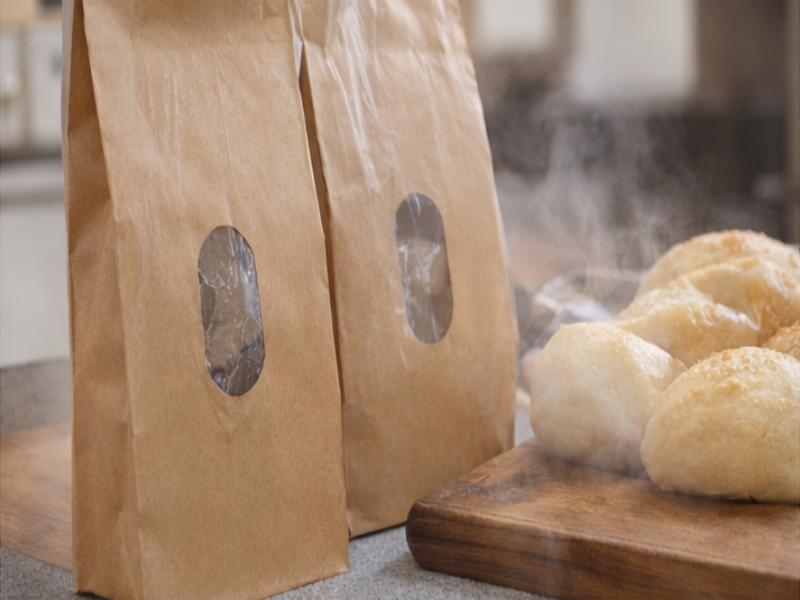
Under normal handling conditions, kraft paper bags with window are not waterproof. Brief contact with dry or slightly damp hands usually does not affect performance. The paper can retain its shape when exposure is minimal and short. Issues appear when moisture exposure becomes sustained. Prolonged contact allows water to penetrate the fibers, reducing stiffness and structural stability. The change is progressive rather than sudden.
Misunderstandings often arise from visual or tactile cues. Thicker paper may feel more resistant, leading to the assumption that it is waterproof. The presence of a window can also create the impression of added protection. In reality, neither thickness nor a window changes the absorbent nature of untreated kraft paper. They may delay moisture effects, but they do not eliminate them.
Moisture resistance depends on multiple factors working together rather than a single property. Paper weight and density influence how quickly water moves through the fibers. Heavier paper generally slows absorption, but it does not stop it. Bag construction also plays a role. Fold lines, corners, and sealed areas are more vulnerable than flat surfaces, especially when pressure is applied.
The window material affects moisture behavior in a different way. Transparent films do not absorb water, but they can trap condensation if temperature changes occur. The interface between paper and film is often the most sensitive area during moisture exposure. Moisture resistance should therefore be evaluated at the system level. Kraft paper bags with window function as combined structures, where paper, film, and seams respond differently to water.
Kraft paper bags with window are often used in their natural, uncoated form to preserve material simplicity. Without a coating or lining, these bags rely entirely on the inherent properties of kraft paper and the way the bag is constructed. Understanding how moisture interacts with this structure is essential before evaluating suitability for specific products.
When no coating or lining is present, moisture moves freely through the paper fiber network. Kraft paper fibers absorb water through capillary action, allowing liquid to travel along interconnected pores. This process does not occur evenly across the bag surface. Moisture typically enters first at folds, corners, and sealing areas, where fibers are compressed or disrupted during bag forming. These zones create easier paths for water penetration than flat paper panels.
Under damp or humid conditions, uncoated kraft paper bags with window experience gradual changes rather than immediate failure. The paper softens as it absorbs moisture, which reduces stiffness and load stability. Over time, repeated exposure can lead to distortion, weakened seals, or loss of shape. The window area introduces an additional boundary between materials. While the film itself does not absorb water, the surrounding paper edges remain exposed and can concentrate moisture stress.
Despite these limitations, uncoated kraft paper bags with window remain suitable in low-risk environments. They are commonly used for products that remain dry throughout storage, transport, and handling, such as dry foods, shelf-stable snacks, or non-food items with no moisture sensitivity. In these cases, the absence of coating allows breathability and reduces the risk of trapped condensation.
Handling and storage conditions play a decisive role in performance. Uncoated bags function best when stored in dry spaces with stable temperatures and limited humidity. Short handling times and minimal contact with damp surfaces further reduce exposure risk. Suitability depends less on the material alone and more on how the packaging environment is managed.
Kraft paper can be modified to reduce water absorption through coatings and treatments applied to its surface or interior. These changes alter how moisture interacts with the paper fibers and affect whether kraft paper bags with window behave as moisture-resistant or closer to waterproof in practice.
Surface coatings and internal linings are the most common methods used to improve water resistance. These layers form a barrier that slows or blocks liquid contact with the fiber network. The paper underneath remains absorbent, but the added layer changes how quickly moisture can reach it. Common approaches include thin polymer coatings, wax-based layers, and bio-based linings. Each differs in thickness, flexibility, and surface coverage.
Coating Type | Material Used | Waterproof Performance | Breathability | Recyclability | Common Applications |
Polyethylene Coating | PE Film | High | Low | Low | Food Packaging, Industrial Use |
Wax Coating | Food-grade Wax | Moderate | Moderate | Low | Food Wrapping, Bakery Products |
Bio-Based Linings | PLA, Other Bioplastics | Moderate | High | High | Eco-Friendly Packaging, Retail |
Surface Sizing | Starch, Resin | Low | Moderate | High | General Use, Printing |
Not all treatments provide the same level of protection. Water-resistant treatments are designed to delay absorption rather than stop it completely. They perform well against brief splashes or high humidity but may fail under continuous contact. Full waterproof barriers aim to block liquid penetration for longer periods, but their performance still depends on edges, seals, and handling conditions.
Adding coatings affects more than water performance. Breathability is often reduced, which can change how moisture behaves inside the package. Limited airflow may increase condensation risk when temperatures fluctuate. Recyclability and material recovery are also affected, as multi-layer structures are harder to separate during standard recycling processes.
Waterproof performance in paper packaging is rarely absolute. Coatings can degrade under heat, friction, or repeated folding. Small defects at seams or cut edges can become moisture entry points. Coated kraft paper should therefore be evaluated as a system, where coatings, structure, and use conditions interact over time.
Choosing between waterproof and moisture-resistant paper starts with understanding real exposure conditions. Decisions should be based on how kraft paper bags with window are used, stored, and handled rather than on assumptions about material performance.
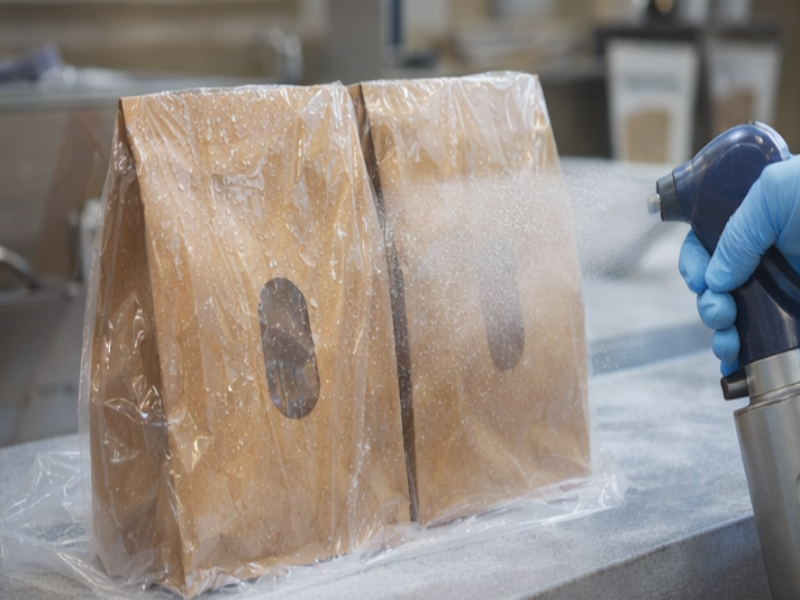
Evaluating moisture risk requires looking at how often and how intensely water may contact the packaging during its lifecycle. This includes production, storage, transport, and end use. Several practical questions help clarify actual exposure:
Question | Impact on Packaging Decision |
Will the package encounter direct liquid contact? | Full waterproofing may be required if yes. |
Are temperature changes likely to cause condensation? | Mild moisture resistance may suffice. |
How long will the product be exposed to moisture? | Long exposure may require stronger coatings. |
These factors help determine whether exposure is occasional or continuous.
In many cases, full waterproofing is unnecessary. Moisture-resistant paper performs adequately when exposure is limited and controlled. This applies to products that remain dry and are stored in stable environments, such as:
● Dry goods stored in climate-controlled spaces
● Short transport routes with minimal handling
● Retail settings with low humidity and stable temperatures
Under these conditions, untreated or lightly treated paper can maintain structure and function without added barriers.
Alternative materials become relevant when moisture exposure cannot be reliably controlled. This includes environments with high humidity, frequent condensation, or direct liquid contact. Examples include:
● Products that release moisture or steam during storage
● Cold-chain transport with repeated temperature shifts
● Outdoor or open-air storage conditions
In such cases, materials designed for sustained moisture protection may provide more predictable performance. The decision should balance material behavior with environmental conditions rather than relying on waterproof labeling alone.
Kraft paper is not inherently waterproof. It is absorbent due to its porous fiber structure. However, kraft paper bags with window can still provide functional moisture resistance in specific conditions.
Choosing the right material depends on how the packaging will be exposed to water. Material-aware decisions can help optimize packaging performance for dry goods or low-moisture environments.
For more reliable moisture resistance, Guangdong Min Sun Environmental Protection Packaging Technology Co., Ltd. offers kraft paper products with specialized coatings and treatments, providing an eco-friendly solution for various packaging needs.
A: No, kraft paper bags with window are not waterproof by default. They are moisture-resistant but may require additional coatings for waterproofing in industrial applications.
A: Kraft paper bags with window are suitable for dry food items where moisture exposure is minimal. For moisture-sensitive products, additional treatment or coatings may be required.
A: The cost of kraft paper bags with window depends on material thickness, coatings, and customization. Bulk orders typically offer cost savings, but waterproofing treatments can increase the price.
A: Kraft paper bags with window may absorb moisture during transport in humid conditions, leading to softening or deformation. Proper storage and additional coatings can mitigate this risk.


