
- All
- Product Name
- Product Keyword
- Product Model
- Product Summary
- Product Description
- Multi Field Search
Views: 0 Author: Site Editor Publish Time: 2026-05-16 Origin: Site


Retailers face a strict dual challenge when merchandising rice products. You must prevent invisible moisture ingress at all costs. You also must structurally support heavy, densely packed grains. Failure on either front often leads to catastrophic seam blowout. Transitioning from traditional rigid containers or weak poly films to engineered flexible solutions is vital. It represents a highly strategic move for modern brands. This shift optimizes precious retail shelf space instantly. It drastically reduces bulk shipping weight across your supply chain. It also demonstrably extends the product's usable shelf life.
A high-performing standup pouch for rice requires precise physical balancing. You need multi-layer moisture barriers mapped to weight-appropriate bottom gussets. High-impact aesthetics also play a massive role. You will learn how to engineer this ideal packaging. Our guide helps you drive robust retail performance while maintaining strict food safety compliance.
Weight determines structure: Select bottom gussets (Doyen, K-Seal, or Flat Bottom) based strictly on the target rice volume (e.g., 1lb vs. 5lbs) to prevent structural failure.
Barrier is a science, not a claim: True waterproof pouch capabilities rely on specific Moisture Vapor Transmission Rate (MVTR) ratings achieved through 3-layer laminated films (e.g., PET/AL/LDPE).
Clear windows require advanced materials: Using ALOXPET instead of traditional aluminum foil allows for product visibility without sacrificing moisture or oxygen defense.
Sustainable claims must be realistic: Navigate eco-friendly options by balancing Post-Consumer Recycled (PCR) content with actual localized recycling facility capabilities.
Standard single-layer films fail frequently in agricultural retail. Sharp rice grains act like tiny rigid needles inside the package. Ordinary plastics remain highly susceptible to these internal micro-punctures. Transport vibrations force the grains against the film walls constantly. Once a tiny breach occurs, moisture contamination ruins the product entirely. Spoilage accelerates exponentially after atmospheric exposure.
Upgrading your rice packaging bag solves this primary operational failure. Multi-layer barrier protection actively shields the granular contents. It blocks oxygen transfer and stops moisture vapor cold. This specific barrier defense extends the extended shelf life (ESL) substantially. Consequently, distributors and retailers experience far lower product return rates.
Logistical advantages also present a compelling financial argument. Flexible laminated bags offer a significantly lower tare weight. They reduce your warehouse footprint dramatically compared to glass jars or rigid cardboard boxes. You ship more actual product and fewer empty packaging materials. This efficiency directly lowers overhead transit costs. It also reduces fuel consumption metrics across your delivery fleet.
Packaging structure depends entirely on your target load weight. A small pouch holding 250g requires completely different load engineering than a bulk product. Heavy grains exert massive downward pressure. You must match the base geometry to the volume.
The Doyen style features a simple round bottom design. It works perfectly for lightweight SKUs under 1lb or 450g. The base curves outward slightly to provide excellent shelf posture. It stands upright cleanly in tight retail display formats. However, it cannot hold heavy weight without sagging.
The K-Seal gusset represents the industry standard for mid-weight loads. We use this for packages ranging from 1lb to 5lbs. The angled diagonal seals distribute the grain weight strategically. They push the pressure away from the primary side seams. This smart geometry prevents bottom blowout during rough transit. It keeps the package structurally intact.
The Flat Bottom or Box Pouch is absolutely necessary for bulk capacities exceeding 5lbs. It maximizes interior volume efficiency flawlessly. The flat square base sits perfectly flush on pallets. You also gain five distinct printable panels for extensive brand messaging. This maximizes your retail marketing footprint entirely.
Gusset Type | Ideal Weight Capacity | Best Retail Application | Structural Benefit |
|---|---|---|---|
Doyen (Round Bottom) | Under 1lb (450g) | Gourmet or sample SKUs | Excellent upright posture |
K-Seal Gusset | 1lb to 5lbs | Standard grocery shelves | Redirects downward stress |
Flat Bottom (Box Pouch) | 5lbs and above | Bulk club stores | Maximum volume efficiency |
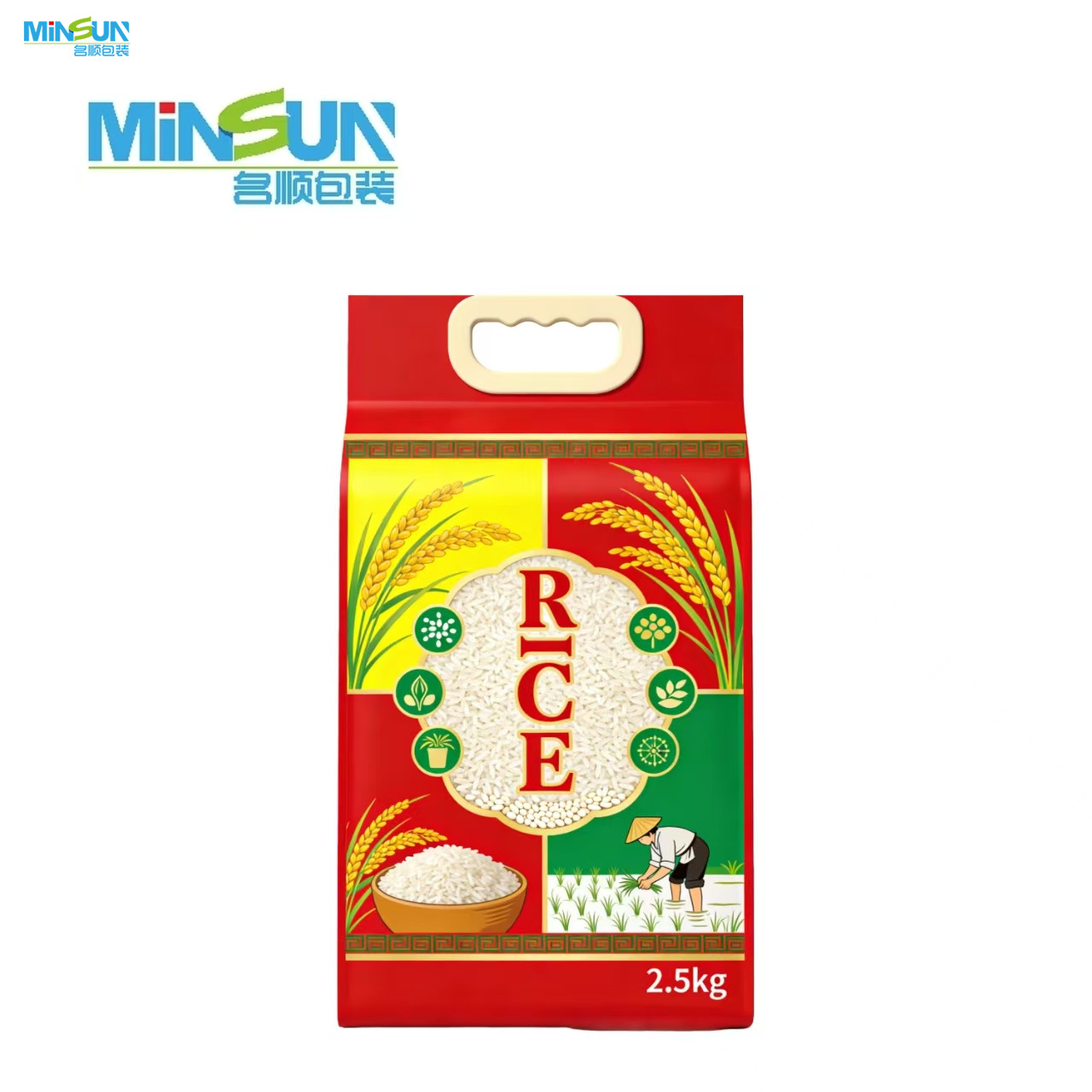
Food-grade flexible packaging relies entirely on precise technical lamination. Experts utilize a proven "sandwich" lamination technique. This methodology creates an incredibly heavy-duty stand up pouch. Each specific layer performs an isolated, critical function. We stack them to build composite strength.
The Outer Layer provides both printability and physical protection. We typically use PET, BOPP, or natural Rice Paper. These substrates offer exceptional scratch resistance. They endure the friction of shipping boxes easily. They also serve as the perfect canvas for high-resolution graphics.
The Middle Layer forms the true core of any waterproof pouch. Traditional barrier designs use solid Aluminum Foil (AL). Foil provides ultimate light and moisture blocking metrics. However, consumer trends demand transparent alternatives today. We use ALOXPET (Aluminum Oxide Coated PET) or EVOH coatings now. These advanced materials maintain strict moisture barriers. They block oxygen effectively while allowing clear display windows.
The Inner Layer ensures reliable heat seal integrity. Food-grade LDPE or PE dictates the ultimate hermetic seal strength. It guarantees compliance for all food packaging applications. It acts directly against the consumable product safely. Larger bulk capacities require vastly thicker PE layers. A 2kg heavy-duty unit often needs up to 130 microns of LDPE to hold the extreme drop weight.
Designing a high-converting custom printed bag demands careful compromise. You must balance the end-user experience against your manufacturing costs. Material choices directly influence perceived brand value.
Printing capabilities dictate your financial scaling strategy. Flexographic printing delivers massive cost-efficiency for bulk orders. It requires initial plate investments but scales beautifully. Digital printing fits perfectly for multi-SKU short runs. It eliminates expensive plate fees for seasonal product variations.
Finish options transform how consumers perceive your product visually. High-gloss films pop aggressively under harsh supermarket lighting. Matte finishes impart a quiet, premium, organic feel. Tactile Soft-Touch films offer a distinct luxury sensory experience. They invite the consumer to hold the product longer.
Functional add-ons remain critical for daily usability. Consider these vital structural upgrades carefully:
Resealability: Push-to-close zippers protect opened rice from destructive pantry pests. They keep humidity out after the initial opening.
Accessibility: U-type or V-type tear notches enable easy, frustration-free opening. Laser scoring ensures a perfectly clean, straight tear across the top.
Merchandising: Euro hang holes allow flexible pegboard display options. Retailers love flexible stocking alternatives.
Sustainability in modern flexible packaging requires absolute honesty. You must aggressively navigate past industry greenwashing claims. Consumers quickly spot misleading environmental promises. Multi-material laminated films represent a massive recyclability challenge currently. Standard Material Recovery Facilities (MRFs) simply cannot process them properly. The mixed plastics tangle inside standard sorting machinery. You must acknowledge this recyclability reality upfront.
We highly recommend pragmatic eco-choices instead of theoretical ones. Utilize high-percentage Post-Consumer Recycled (PCR) materials immediately. Sourcing PCR reliably lowers your brand's overall carbon footprint today. This proactive step is measurable and real. It remains far better than relying on distant "thin-film recyclability" promises. Local municipalities lack the infrastructure to handle flexible films currently.
Maintain rigid chemical safety baselines above all else. Your environmental goals must never compromise human safety. Ensure every supplier specification document explicitly states crucial compliance metrics. They must guarantee BPA-free material formulations natively. They must certify PFAS-free barrier coatings thoroughly. Finally, they must prove FDA direct-contact compliance without any ambiguity.
Guessing dimensions based purely on weight creates immense scalability risk. You will inevitably experience severe over-ordering or annoying manufacturing spillage. Rice density varies drastically by specific agricultural type. Jasmine behaves entirely differently than Basmati or Arborio grains inside a hopper.
Always implement a strict sizing matrix framework. Request precise dimensional volume mapping from your manufacturing supplier. Measure the Width by Height plus the Bottom Gusset span. Match these exact dimensions to specific micron thicknesses. Thicker walls reduce the internal volume capacity slightly. You must account for this material displacement.
Follow a rigorous validation process before committing capital:
Request unprinted physical stock samples immediately. Conduct rigorous in-house volume fill tests and concrete drop tests.
Review Master Art Proofs meticulously. Confirm precise zipper-to-seal distances to avoid filling machine jams on your line.
Evaluate your Minimum Order Quantity (MOQ) tiers intelligently. Leverage digital short runs of 100 to 500 pieces first. Use these specifically for actual market testing. Only then should you commit to massive 10,000-unit plate-printed production runs.
Mitigating physical risk remains your primary structural goal. You must balance extreme weight support and moisture defense seamlessly. Prioritize material science transparency during your vendor selection process. Choose manufacturers who eagerly provide specific OTR and MVTR laboratory data. Avoid those competing purely on cheap unit costs. Favor suppliers who offer rapid, accurate physical prototyping.
Take actionable steps to secure your supply chain today. Calculate your exact volume-to-weight ratio for your specific grain type. Reach out to qualified manufacturers for a physical sample pack immediately. Conduct your own structural drop testing to guarantee retail success. Upgrading your barrier films will inevitably protect your brand reputation and your profit margins.
A: Yes. By substituting traditional aluminum foil with ALOXPET or EVOH-coated films, you easily achieve a clear display window. These advanced materials maintain strict moisture and oxygen barriers while offering full visual transparency.
A: Digital printing allows for MOQs as low as 100 to 500 units. This is ideal for initial market testing. Traditional plate printing usually requires 10,000+ units but offers a significantly lower cost per unit at scale.
A: Switch from a standard Doyen round bottom to a K-Seal or Flat Bottom gusset. Ensure your inner LDPE heat-seal layer is explicitly spec'd to at least 120-130 microns for heavier loads exceeding one kilogram.


