
- All
- Product Name
- Product Keyword
- Product Model
- Product Summary
- Product Description
- Multi Field Search
Views: 0 Author: Site Editor Publish Time: 2026-05-19 Origin: Site


Have you ever opened a premium treat only to find it stale? Premature moisture ingress degrades product crispness and destroys brand trust. This hidden spoilage shrinks shelf life rapidly. It directly impacts retail margins and harms your brand reputation. Consumers expect a perfect crunch every time they open a package. Commercial-grade preservation requires highly engineered physical barriers. You cannot rely on basic single-layer plastics. Moisture-sensitive products demand robust, uncompromising protection. A specialized moisture proof packaging bag blocks invisible vapor threats effectively. This article deconstructs moisture barrier technologies and analyzes effective material laminations. You will learn how high-barrier demands intersect new eco-friendly options. We clarify emerging safety standards for modern food preservation. We also provide actionable tips for selecting reliable manufacturing partners.
Achieving an 18–24 month shelf life for highly sensitive products requires specific multi-layer laminations (e.g., PET/AL/PE).
The term "seaweed bag" serves two distinct markets: high-barrier packaging *protecting* roasted seaweed snacks, and emerging bioplastic packaging made *from* seaweed extract.
Verified food grade packaging must offer inert physical barriers that do not chemically interact with the food, alongside measurable Moisture Transmission Rates (MTR).
Custom structural features (stand-up formats, resealable zippers) bridge the gap between technical preservation and consumer convenience.
Inadequate moisture defense carries a severe financial penalty. Compromised packaging leads directly to staling and lipid oxidation. Low-moisture goods lose their crucial crunch quickly. Customers notice this texture degradation immediately. Retailers routinely issue expensive chargebacks when products spoil before their expiration date. They pull defective units from shelves and penalize the manufacturer. Good snack packaging prevents these costly retail disruptions. Investing in premium barrier materials saves money long-term. It reduces waste, maintains inventory integrity, and ensures steady profit margins.
Buyers must evaluate specific technical metrics during procurement. Moisture Transmission Rate (MTR) defines barrier success. MTR measures how much water vapor passes through a square meter of material daily. Lower MTR values indicate superior moisture resistance. Buyers must also check mechanical durability. Tensile Strength (TS) must exceed 7 MPa for commercial viability. High tensile strength prevents material tearing during transit. Another critical metric is elongation at break. This measures flexibility under stress. Packaging must withstand rough handling without rupturing the inner seal.
True preservation relies on dense material layers. Many companies mistakenly rely on chemical preservatives mixed into the food. A highly engineered moisture barrier eliminates the need for excess internal preservatives. Impermeable material layers block external humidity mechanically. The barrier remains entirely inert. It protects the contents without altering flavor profiles. Physical defense provides a safer, cleaner label for health-conscious consumers. It keeps moisture out organically through advanced polymer science.
Single-layer plastics fail consistently in commercial applications. Microscopic pores in basic polymers allow vapor transmission over time. Multi-layer composite lamination serves as the global industry standard. Engineers bond different functional films together. This creates a synergistic barrier. One layer provides printability, another blocks moisture, and the inner layer allows heat sealing. A reliable food packaging pouch requires this layered approach. Laminating multiple substrates eliminates microscopic vulnerabilities entirely.
Different products require distinct lamination recipes. Manufacturers tailor these structures based on moisture sensitivity and retail display goals.
Lamination Structure | Key Characteristics | Barrier Level | Primary Application |
|---|---|---|---|
PET/AL/PE | Incorporates pure aluminum foil. Offers 100% light-blocking and near-zero MTR. | Extreme | Highly sensitive snacks, roasted seaweed, premium coffee. |
PET/NY/PE | Features a nylon (NY) core layer. Engineered for maximum puncture resistance. | High | Vacuum-sealed products, sharp dry goods, frozen items. |
OPP/CPP | Provides excellent transparency. Leaves the product visible to the consumer. | Moderate | Baked goods, candies, items needing clear display windows. |
Packaging thickness directly influences protective capabilities. Commercial snack films typically range from 20 to 200 microns. Thickness converts to roughly 1 to 8 mils. Lightweight snacks require thinner profiles around 50 microns. Heavy or sharp products demand thicker walls up to 150 microns. Thicker films resist puncture forces during automated filling. However, excessive thickness increases material costs unnecessarily. You must balance barrier strength against unit economics. Factory engineers can recommend optimal micron levels based on your specific food weight.
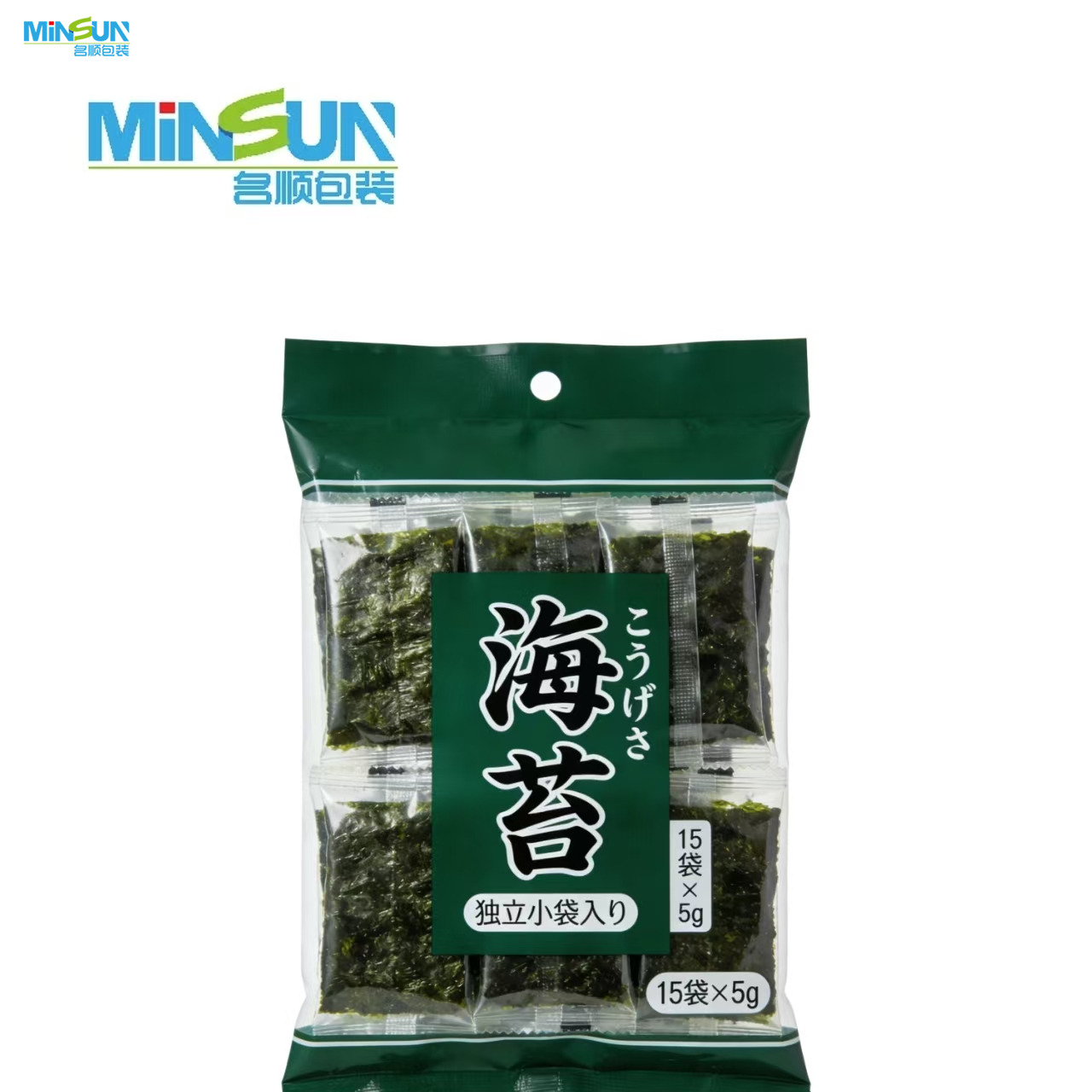
Roasted seaweed demands extreme physical protection. These delicate sheets absorb ambient humidity instantly. Even minor moisture exposure ruins the characteristic crunch. A dedicated seaweed bag must offer absolute vapor blockade. Experts recommend multi-layer foil laminates like VMPET or pure AL. These metallic layers extend shelf life up to 18–24 months safely. They also block ultraviolet light perfectly. Light exposure degrades the natural green color and oxidizes residual oils. Foil structures guarantee long-term crispness across global supply chains.
A secondary definition involves packaging constructed from algae. This represents a massive shift toward sustainable material science.
Marine-based bioplastics excite eco-conscious brands globally. Manufacturers extract natural polymers like alginate and agar. These materials form 100% edible, compostable films. They leave zero microplastic residue behind. Seaweed grows rapidly in saltwater environments without requiring arable land. It sequesters carbon naturally during cultivation. This offers a compelling narrative for green marketing campaigns.
Pure seaweed films possess a fatal engineering flaw. They demonstrate weak intrinsic resistance to water vapor. The material dissolves easily upon contact with moisture. You cannot use pure alginate as a standalone moisture barrier. Currently, these films suit short-term contact applications only. They work well as dry inner linings or instant-noodle flavor packets. Commercial viability requires applying advanced nanocoatings to the bioplastic surface. Until this coating technology scales, traditional laminates remain necessary for long-term retail preservation.
Structural formatting influences merchandising success heavily. Stand-up pouches utilize a strategic bottom-gusset design. The gusset expands as the bag fills. This allows the package to stand perfectly upright on shelves. It reduces wasted retail shelf space significantly. SUP formats present a large, flat canvas for branding. A well-designed moisture barrier bag easily accommodates automated filling machinery. Factories use Vertical Form Fill Seal (VFFS) or Horizontal Form Fill Seal (HFFS) machines. Stand-up designs streamline these high-speed packing processes perfectly.
Consumers rarely finish premium snacks in one sitting. Once they tear the seal, ambient moisture enters freely. Premium packaging demands robust resealable zippers. A zipper maintains the internal microclimate after the initial opening. It provides vital portion control for health-conscious buyers. Resealability extends the functional life of the product at home. It prevents food waste and keeps the snack crispy longer. Brands incorporating high-quality press-to-close zippers see higher repeat purchase rates.
Small physical modifications drive user experience upward. Consider these cost-effective structural upgrades for your next production run:
Tear Notches: V-notch or laser-scored lines enable clean, effortless opening without scissors.
Hang Holes: Euro-slot or round holes allow versatile pegboard merchandising in convenience stores.
Degassing Valves: One-way valves release internal pressure. They prove essential if you cross-purpose bags for high-gas-emitting foods like freshly roasted coffee.
Rounded Corners: Eliminating sharp edges prevents consumer injury and stops bags from puncturing each other in transit boxes.
Procurement teams must demand strict safety compliance. "Food grade" is not just marketing jargon. It requires documented chemical safety. A legitimate food grade pouch contains absolutely zero Bisphenol A (BPA) or Phthalates. The inner sealing layer must be free of PVC elements. Top factories utilize solvent-less lamination machines. This process eliminates Volatile Organic Compounds (VOCs) from the factory floor. It prevents chemical off-gassing into your food. Additionally, outer printing must use heavy-metal-free, food-safe inks.
Choosing the right manufacturing partner dictates your packaging success. You must audit their specific production capabilities before signing contracts.
First, evaluate their Minimum Order Quantities (MOQs). Custom rotogravure printing typically requires starting runs of 10,000 to 20,000 units per design. Digital printing offers lower MOQs but higher unit costs. Second, clarify standard lead times. A reliable factory needs 12 to 15 days post-artwork approval to deliver custom configurations. Finally, check their advanced printing capabilities. A premium snack bag often uses CMYK processes capable of printing up to 10 colors. Ask if they can apply mixed finishes, like matte backgrounds accented by glossy logo elements.
Sending a vague Request for Quote (RFQ) causes severe delays. Build a standardized framework to reduce friction with overseas suppliers. Use this exact checklist to secure accurate pricing immediately:
Bag Type: Specify the exact format (Stand-Up Pouch, Flat Bottom, 3-Side Seal).
Dimensions: Provide Width, Height, and Bottom Gusset depth in millimeters.
Material Structure: State your requested lamination (e.g., PET/AL/PE) or ask for engineering recommendations based on your product.
Thickness: Define the micron requirement (typically 80-120 microns for snacks).
Colors: Specify the number of printed colors and any special finishes (spot UV, metallic inks).
Volume: State your target order quantity clearly to secure tiered volume discounts.
Add-ons: Mention required zippers, tear notches, or hang holes.
Protecting snack investments requires scientific material selection. You must match the moisture sensitivity of your food to the correct lamination barrier. Use pure aluminum structures for extreme preservation needs. Choose clear barrier films only when visual display outranks maximum shelf life. Sustainable materials like seaweed derivatives show immense promise. However, multi-layer laminated pouches remain the safest commercial bet right now. They guarantee maximum moisture protection and retail stability. Audit your current packaging specifications today. Request physical sample bags from verified suppliers. Conduct real-world shelf-life testing to ensure your product stays perfectly crisp.
A: A bag achieves complete moisture proofing through strategic multi-layer lamination. Manufacturers embed metallic layers like pure Aluminum (AL) or metalized polyester (VMPET) inside the polymer structure. These dense metal barriers stop moisture vapor transmission entirely. Porous single-layer plastics fail because water molecules eventually pass through their microscopic gaps.
A: High-barrier compostable films exist today. However, they are significantly more expensive to produce. Matching traditional foil barrier performance requires complex, multi-layer biodegradable structures. Pure biomaterials often struggle with moisture defense. They require advanced nanocoatings to mimic the vapor-blocking power of conventional PET/AL laminations.
A: Most commercial snack pouches range between 50 to 150 microns. This equals approximately 2 to 6 mils. Lightweight items like chips do well around 50-80 microns. Heavier or sharper products require 100-150 microns to prevent transit blowouts and internal punctures.
A: You must advise your supplier to provide official manufacturer certifications. Request SGS or FDA compliance reports for direct food contact materials. Verify they use BPA-free polymers. Always insist they utilize solvent-less lamination and food-safe adhesives during the manufacturing process to prevent chemical migration.


